
You found the land. Maybe it’s been in the family for years, or maybe you just closed on a few acres outside of town and you can already picture the porch, the driveway, the spot where the kids will play. That feeling is real, and it’s worth holding onto. But before you fall all the way in love, there’s a quieter question worth asking: can you actually build the home you’re imagining on this exact piece of ground?
Building on land you already own is one of the smartest ways to build a custom home in Southeast Missouri right now — lots and small acreage are opening up around Cape Girardeau and Jackson, and land you already hold gives you a real head start. It just pays to look before you leap. Here’s what a good builder checks before you commit, so there are no surprises later.
Table of Contents
Why Building on Land You Already Own Starts With a Site Walk
A lot can look perfect from the road and still hide costs underneath it. The most expensive surprises in homebuilding almost never come from the house itself — they come from the ground it sits on. That’s why the very first thing we do at Trawick Homes is walk the land with you.
A site walk isn’t a formality. It’s where we spot the things that shape your budget before a single line gets drawn: how the land slopes, where water goes when it rains, how far utilities have to travel, and whether that beautiful stand of trees is a feature or an obstacle. Twenty minutes on the property together tells us more than an hour looking at a plat map.
Southeast Missouri ground varies a lot from one parcel to the next — river-bottom soils, rocky hillsides, and clay-heavy lots all behave differently. Knowing what you’re standing on is step one.
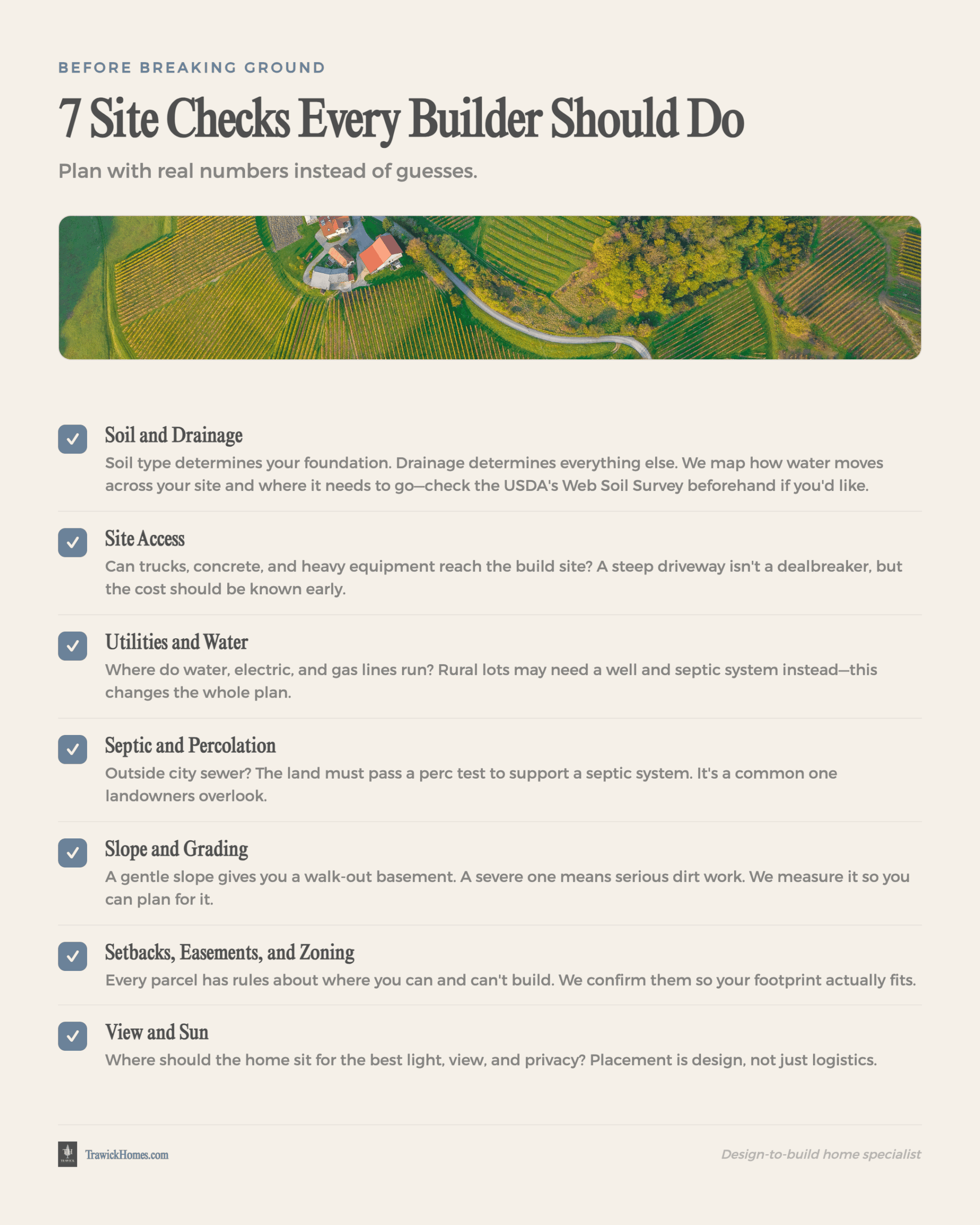
The 7 Things a Good Builder Checks Before You Build
Here’s the short version of what we’re really looking at when we evaluate a lot. None of these should scare you off — they simply help you plan with real numbers instead of guesses.
- Soil and drainage. Soil type affects your foundation, and drainage affects everything. We look at how water moves across the site and where it needs to go. You can even preview soil data for any parcel through the USDA’s Web Soil Survey before we ever meet.
- Site access. Can trucks, concrete, and heavy equipment reach the build site? A long or steep driveway isn’t a dealbreaker, but it’s a cost worth knowing early.
- Utilities. Where are water, electric, and gas — and how far do they have to run to your build site? Rural lots sometimes need a well and septic instead, which changes the plan.
- Septic and percolation. If you’re outside city sewer, the land has to pass a perc test to support a septic system. This is a common one landowners forget.
- Slope and grading. A gentle slope can give you a gorgeous walk-out basement. A severe one can mean serious dirt work. We measure it so you can plan for it.
- Setbacks, easements, and zoning. Every parcel has rules about where you can and can’t build. We confirm them so your dream footprint actually fits.
- The view and the sun. The fun part — where the home should sit to catch the best light, the best view, and the most privacy. Placement is design, not just logistics.
The Hidden Costs Landowners Forget to Budget For
When people build on land they already own, they often assume the “land part” is done — they own it, so it’s paid for, right? Not quite. Getting a raw or partially cleared lot ready to build is its own line in the budget, and it’s the one first-time builders most often overlook.
Site prep can include clearing and grubbing, grading, bringing in fill, extending a driveway, running utilities to the home, drilling a well, or installing a septic system. On a smooth in-town lot, that number is small. On a wooded acreage with a long approach, it can be meaningful. Neither is wrong — you just deserve to see the real cost before you fall in love with a plan you can’t quite reach.
This is exactly where a transparent, budget-based contract earns its keep. When we evaluate your lot up front, those site costs go into the plan from day one — not onto a surprise invoice halfway through the build.
A Quick Way to Pressure-Test Your Numbers
Before you spend a dollar on plans, it helps to know the ballpark your land and budget put you in. Our free Real-Home Planning Guide walks landowners through the questions to ask, including a lot-evaluation checklist you can use on your own property this weekend.

How Trawick Homes Evaluates Your Lot — Step by Step
We keep this simple on purpose. Building should feel clear, not confusing.
It starts with a conversation about your vision and your budget. Then we walk the land together, note what we see, and flag anything that affects cost or design. From there, we design a home that fits your lot — not a stock plan forced onto ground it doesn’t suit — and we build the site costs into a transparent budget you can actually trust.
Throughout the build, you get weekly updates through our client app, so you’re never left guessing. One team, from the first lot walk to the final walkthrough. That’s the whole idea — clarity, care, and craftsmanship, from blueprint to move-in.
Frequently Asked Questions
Q: Can I build on land I already own in Southeast Missouri?
A: In most cases, yes — and it’s a great head start. The key is confirming the lot is buildable, which means checking soil, drainage, access, utilities, and local zoning first. A quick site walk with your builder answers most of these questions early.
Q: What makes a piece of land hard to build on?
A: The most common challenges are poor drainage, steep slopes, difficult soil, no easy utility access, or failing a septic perc test. None of these automatically rule a lot out — they just affect your budget and design, which is why it’s worth checking before you commit to a plan.
Q: How much does it cost to prepare land for building?
A: It varies widely based on the lot. A flat, in-town parcel with utilities at the street costs far less to prep than a wooded rural acreage needing clearing, a long driveway, a well, and a septic system. Evaluating the site up front lets us give you a real number instead of a guess.
Q: Do I need a perc test before building?
A: If your lot is outside municipal sewer service, yes — a percolation test confirms the ground can support a septic system. It’s a small step that prevents a big surprise, and we help coordinate it as part of evaluating your land.
You Own the Land. Let’s Make Sure It’s Ready for Your Home.
Owning your land already puts you ahead — you’ve done the hard part. The next step is making sure the ground is ready for the home you’re dreaming about, so you can move forward with confidence instead of crossed fingers.
If you’ve got a lot in the Cape Girardeau or Jackson area and you’re wondering what it would really take to build on it, let’s walk it together. Book a free planning call or lot walk with Marshall, and grab the free Real-Home Planning Guide while you’re at it. No pressure, no obligation — just honest, local answers from a builder who actually communicates.